
Rigour Meets Passion: Refining Our Roadmap with Sarina Russo & Craig Condy
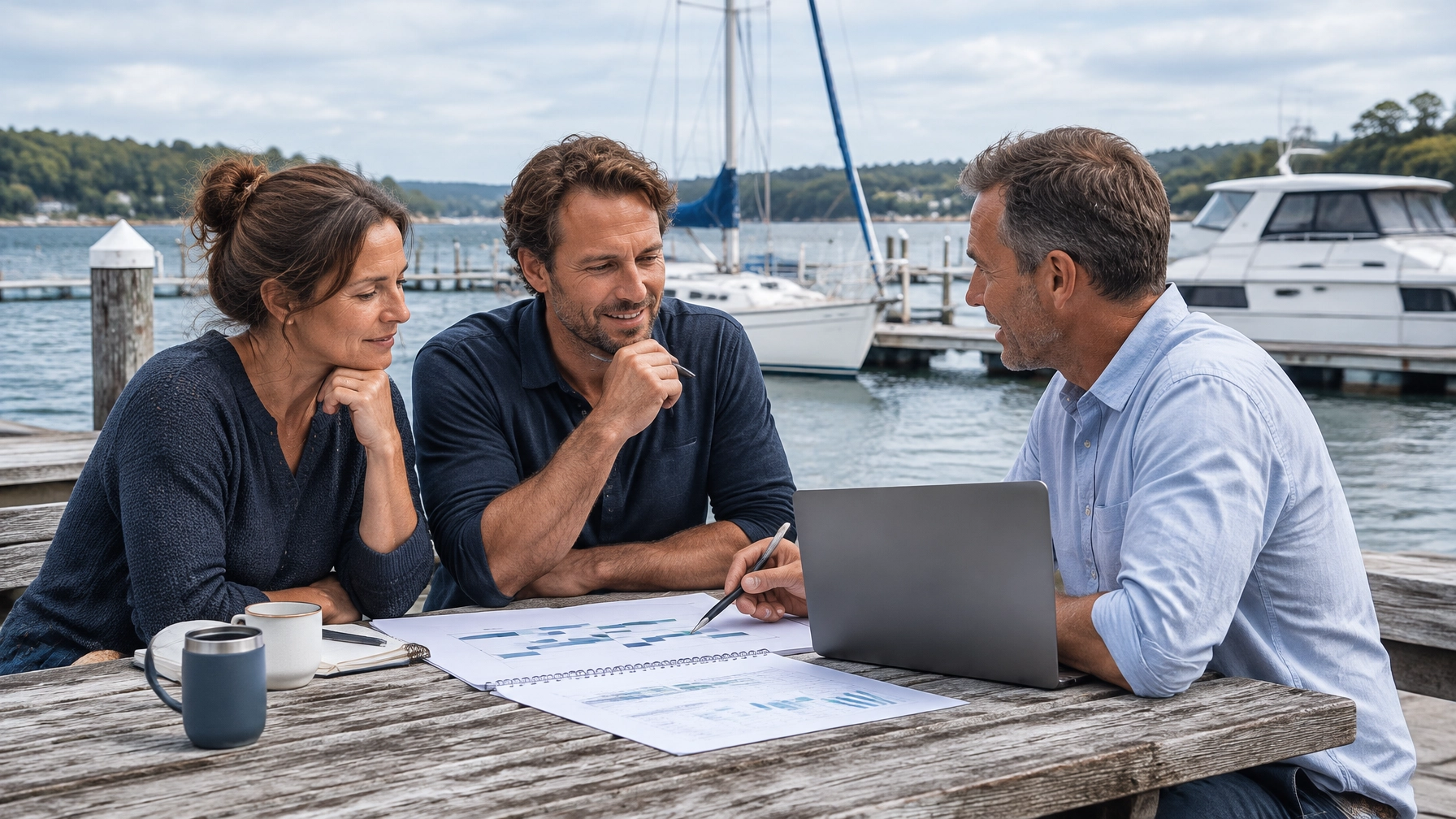
A lived frustration can spark a business, but building a platform around it takes careful planning. For MarineTasker, structured coaching helped turn the founders’ experience of finding dependable dockside help into a clearer business model, a more considered financial plan and a practical launch sequence.
After sharing the thinking behind MarineTasker’s origins in Post 1, the next step was to test the idea against the realities of building a two-sided marketplace. Martin and Sharon Sheridan brought the business into the Sarina Russo Entrepreneurs. There, business coach Craig Condy helped them work through the commercial questions behind the concept.
A coach who knows the marine world
Craig brought an unusual combination to the conversations: business coaching experience and firsthand time in the marine industry. Before becoming a business coach with Sarina Russo Group, he spent nearly a decade working as a superyacht deckhand and engineer in the Mediterranean. His background also includes an RYA Yachtmaster qualification and trade certificates in areas including motor mechanics, electronics, welding and refrigeration.
That experience mattered. MarineTasker isn’t being designed in the abstract. Its founders know the day-to-day friction of life aboard and the challenge of finding reliable help in unfamiliar places. Craig understood the dockside context, too: the distance between a promising idea and a business model that can work for owners, trades and skilled local hands.
Martin brought serious depth to the coaching sessions as well. His career spans business technology, strategic investment, product management and marketing — more than 30 years of it — and he works with the mindset of a product architect steeped in agile and lean startup practice: build small, test early, measure honestly, iterate. That background proved fundamental during the business planning and financial modelling with Sarina Russo. Martin was able to model the marketplace’s unit economics properly, stress-test assumptions with real scenarios and translate a customer-first vision into product decisions that could actually be built and shipped in stages. It’s the difference between a passion project and a platform.
Through Sarina Russo Entrepreneurs, eligible new business owners can access support such as business coaching, planning and training. The City of Wollongong’s information on local business advice describes the practical focus of this kind of support. For MarineTasker, coaching provided a structured way to examine assumptions and strengthen the plan.

From a compelling idea to a testable model
A marketplace has to work for both sides. Boat owners need a straightforward way to find suitable help and compare proposals. Marine trades and capable local hands need worthwhile opportunities, clear job scopes and a fair path to payment.
That means the business model can’t focus only on attracting owners or signing up providers. It has to account for the effort required to quote, the cost of winning work, and the confidence people need before arranging a job at a berth, mooring or slipway.
Coaching helped sharpen MarineTasker’s attention on those questions. The aim was to test how the platform could reduce wasted quoting effort for providers, clarify the value offered to owners and build a business with sustainable unit economics, without placing unnecessary costs between a customer and a job.
That contractor-first thinking is reflected in the current plan: zero quoting fees, $0 lead fees and no monthly subscriptions. Founding trades are offered a fixed 10% commission on their first 20 jobs or six months. These choices are intended to help local providers build a presence on their home waterways while giving the marketplace a manageable starting point.
Passion-led plan vs coaching-refined plan
| Planning area | Early instinct | Refined direction |
|---|---|---|
| Launch approach | Build for every waterway at once | Launch corridor by corridor, beginning with Greater Sydney & Broken Bay |
| Provider intake | Open enrolment from day one | Cap founding places by trade category and local corridor |
| Provider costs | Risk of unclear fees or costly leads | $0 monthly subscriptions and no quoting or lead fees; founding trades have a defined commission offer |
| Marketplace value | Lead with a long list of features | Prioritise trust, clear scopes and planned upfront safe payments |
| Roadmap | Build everything before testing locally | Sequence milestones around a focused first launch and future corridors |
The table captures the direction of the planning, not a claim that every roadmap feature is already available. MarineTasker is still preparing for launch, and features such as upfront safe payments, two-way ratings, pay-per-job insurance, and the digital vessel logbook are part of the platform’s planned offering.
A staged launch that matches the work
It’s tempting to promise national coverage from the outset. But a two-sided marketplace needs enough relevant activity in each location: owners who need work done and providers able to take it on. Spreading resources too thin can leave both sides waiting.
The roadmap therefore starts with Greater Sydney and Broken Bay in January 2027, including waterways such as Sydney Harbour and Pittwater. The planned sequence then moves to Lake Macquarie and Newcastle in April 2027, followed by Queensland in July 2027.

A corridor-by-corridor rollout gives MarineTasker a more focused way to build local coverage, learn from each phase and prepare for the next. It also gives trades and skilled hands a clearer sense of where the platform is heading, rather than asking them to wait for a vague promise of nationwide activity.
That sequencing depends on milestone planning, too: deciding what needs to be ready for launch, what can follow, and how progress in one corridor informs the next. It’s a less dramatic approach than trying to be everywhere at once, but a more grounded one for a marketplace that depends on local trust and availability.
Rigour without losing the reason for building
Financial modelling and operational planning aren’t separate from the purpose of MarineTasker. They’re part of making the idea viable. If trades spend less time chasing dead leads and owners can find the right level of help for their job, the marketplace has a better chance of serving both sides well.
That’s the balance coaching helped bring into focus: keep the original problem visible, but test the assumptions around it. Prioritise the economics of the people doing the work. Launch where a useful local network can be built. Make decisions in stages, then keep learning.
MarineTasker is being built as a technology platform and workflow facilitator, not as a marine contractor. Its role is to help owners and providers connect through clearer job information, discoverable local expertise and planned tools for trust and payment. The broader goal is simple: Many hands make light work.
We’re grateful to Craig Condy and Sarina Russo Entrepreneurs for helping us bring rigour to the roadmap while keeping its purpose firmly in view.
Join the MarineTasker Open Beta waitlist at marinetasker.io/beta.
Frequently asked questions
Who coached MarineTasker as it refined its business plan?
MarineTasker worked with Craig Condy, a business coach with Sarina Russo Entrepreneurs.
When is MarineTasker’s first planned launch?
Greater Sydney and Broken Bay are scheduled to launch in January 2027, followed by a staged rollout into other waterways.
Get first access to verified dockside care.
Join the Sydney Harbour & Broken Bay Open Beta. Lock in $25 toward your first Task or secure a 10% Founding Provider spot.
Lock In Founding Access